
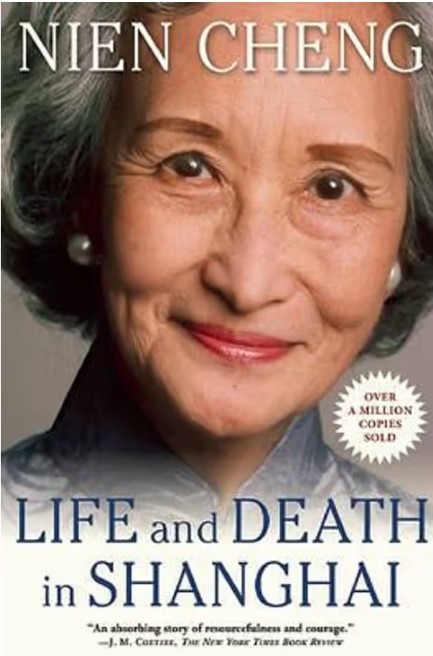
At a March meeting of the PEN International Women Writers Committee, Sotiria Georganti focused on a selection of banned books around the world and spotlighted Life and Death in Shanghai by Nien Cheng (1915–2009). As a memoir documenting the Red Guards’ cruelty and the Chinese Cultural Revolution’s chaotic nature, it is prohibited for sale in China. It runs counter to the official Chinese Communist Party’s narrative being that Mao was correct in intending to fight revisionism but this was corrupted by counter-revolutionary cliques – specifically Lin Biao and the so-called Gang of Four.[1]
Amongst a short list of thirty books banned in China, this is second to the better-known Jung Chang’s Wild Swans: Three Daughters of China.[2]
Life and Death in Shanghai (1987, written in English, and then translated into Chinese in 1988) is the firsthand account of Nien Cheng’s incarceration during the Cultural Revolution highlighting the emotional and physical cost to her as a bourgeois living until then a charmed life with servants and good money from working with Shell Oil. Not only is it surprising to learn that in Communist China such a lifestyle was allowed, pointing at a corrupt elite, but it is also an unusual approach for a personal chronicle of the Cultural Revolution, often authored by Red Guards or intellectuals.[3]
During more than six years of solitary confinement and torture, Nien Cheng resisted ‘denouncing’ other ‘capitalist privileged’ people, and ‘confessing she was a spy for the West’. (Burn, 2011)[4] In her book, she relates her exchanges with Red Guards interrogating her, quoting back at them Mao’s Little Red Book: “I will obey our Great Leader Chairman Mao’s teaching. […] Firstly, do not fear hardship, and secondly, do not fear death.” (Burn, 2011) It only enraged them further. Her strength and eloquence in the face of harassment and poor health make Life and Death in Shanghai one amongst many accounts of remarkable resistance to torture in China, but also in other countries.[5]
Such a persecution against Cheng may be interpreted as part of “a power play put together by the faction supporting Defence Minister Lin Biao against Premier Zhou Enlai.” (Burn, 2011) But it is also known that, out of fanatism, Red Guards exceeded the power given to them during those anarchic years. When she was eventually freed in 1973, Cheng learned her own daughter had been murdered years before during interrogations aimed at getting her to ‘denounce’ her own mother. (Lynch, 2011)[6]
In 1980s, as the Chinese Communist Party relaxed its grip on the nation, Nien Cheng was granted a visa to visit her family in the US. At 65, she took this opportunity to apply for political asylum in Canada, and then migrate to the US. When touring for the promotion of her book, Cheng stressed that she was using her privilege to speak on behalf of the 10,000 victims of the Cultural Revolution in Shanghai alone, and those who have survived but never recovered.
[1] J. Llewellyn & S. Thompson, “The historiography of the Cultural Revolution”, Alpha History, Accessed 6 April 2026, https://alphahistory.com/chineserevolution/historiography-cultural-revolution/.
[2] Listopia : Banned China Books, Goodreads, Accessed 6 April 2026, https://www.goodreads.com/list/show/4808.Banned_CHINA_Books#:~:text=1.,Candy.
[3] See, for instance, Ma Bo’s Blood Red Sunset (1995).
[4] John F. Burns, “Summer Reading: A prisoner of the Thought Police”, New York Times, 31 May 1987, Accessed 6 April 2026.
[5] A small selection of firsthand accounts of political torture: Henri Alleg’s The Question (1958); Louisette Ighilahriz and Anne Nivat’s Algerian (2001); Alicia Partnoy ‘s The Little School: Tales of Disappearance and Survival in Argentina (1998); Mansoor Adayfi’s Don’t Forget Us Here: Lost and Found at Guantanamo (2021).
[6] Elizabeth Lynch, “Book review: Nien Cheng’s Life and Death in Shanghai”, China Law and Policy, 8 May 2011, Accessed 6 April 2026.
 penperth.com