
Since the 1979 Revolution, book banning in Iran has been a constant. Religious, political and moral grounds against foreign and local authors were at their most severe for the twenty years preceding the Reform period (1997–2005; see The Dial).[1] Some relaxation of the rules occurred then, but President Mahmoud Ahmadinejad (2005–2013) engineered a backlash against Western literature. In 2013, the then Ministry of Culture announced a relaxation on those bans and a revision on the existing list granting publication permits.[2] Yet, according to the Centre for Human Rights in Iran, these promises were mere empty rhetoric, and books by foreign and Iranian authors alike are still being banned.
It will surprise no one to hear that Salman Rushdie’s Satanic verses and Midnight Children are banned in Islamic Iran on blasphemy charges. Other foreign authors like Virginia Woolf, William Faulkner and Fyodor Dostoevsky are “deemed to promote Western cultural influence, undermine Islamic values, or potentially humiliate Iranian youth” (see The Dial). [3] Dan Brown’s The Da Vinci Code (2003) is banned for upsetting the tiny Christian community in Iran. Tracy Chevalier’s Girl with a Pearl Earring portraying inappropriate, intimate themes has also been banned during “a 2006 crackdown on Western literature under President Mahmoud Ahmadinejad” (2005–2013). The new leader argued at the time that the preceding Reform period (1997–2005) had allowed too many foreign and local books to be published (see The Dial).[4]
Most banned books, however, are written by Iranian authors in the official language, Farsi. Here are four examples.
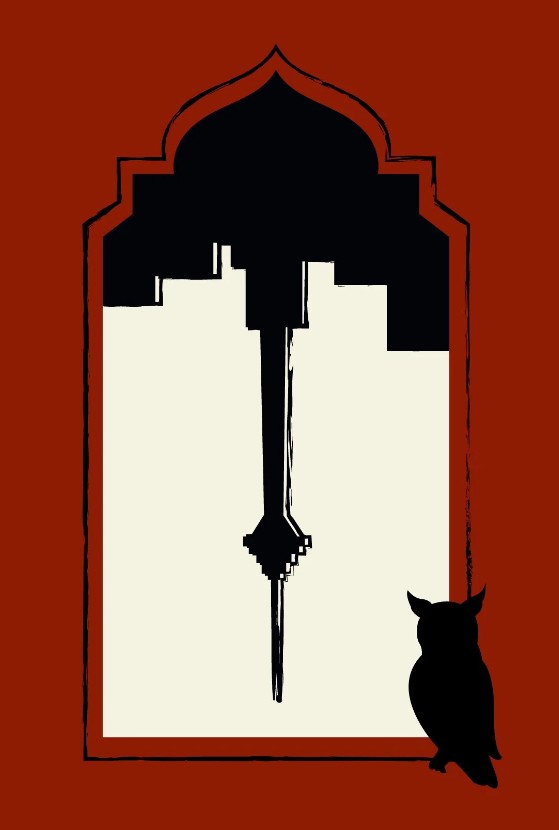
Sadeq Hedayat’s 1936 novel The Blind Owl: A pre-revolutionary masterpiece banned before and after the 1979 Revolution. It is deemed to encourage suicide and pornography. Hedayat (1903–1951) was a translator, a poet, a satirist who took his own life while in exile in Paris in 1951. Originally, The Blind Owl was self-published in Mumbai with just 50 photocopied, stapled booklets. In it, Hedayat depicts two historical eras: the pre-Islamic world, which he revered, and Iran after the Arab takeover, which he despised. The book allows for many, and often contradictory, readings: it might be both a celebration of death and an affirmation of life, or a reinforcement of sexism and an exercise in queer literature. Hedayat has influenced countless modern-day Iranian authors.
Gholam Hossein Sa’edi (1936–1985) was indeed influenced by Sadeq Hedayat’s novels and, in turn, inspired Persian writers with his innovative brand of social realism. He had to flee Iran after the 1979 Revolution. He was a prolific author whose books are still banned in his home country. Like Hedayat, he died a pauper in Paris.
Abbas Milani’s The Shah (2011) is the biography of Mohammad Reza Pahlavi, the last Shah of Iran. Even though Milani had been persecuted and imprisoned by the Shah and the Ayatollah forces, his biography is deemed an objective historical work, yet the ban has never been lifted.
Lastly, a book everyone knows in the West: Marjane Satrapi’s Persepolis (2003), a two-volume autobiographical graphic novel. By telling the story of a young girl growing up in Iran during the 1979 Revolution,[5] it has been banned for its candid portrayal of daily life during the Islamic overturn of the Shah.
There are multiple ways censorship can be applied in Iran. Books must receive print and distribution permits. Sometimes permits are simply withheld; other times books must be revised to be allowed to be printed and sold. “A book has to go through several rounds of censorship before it can be published in Iran. […] The process has deeply impacted free speech in Iran, as well as the quality of book and other literature translations.” [6] In 2013, the then Ministry of Culture announced a relaxation on those bans and a revision on the existing list to give publication permits.[7]
According to the Centre for Human Rights in Iran, these promises were mere empty rhetoric, and books by foreign and Iranian authors alike are still being banned. When reasons are given, they are of three types: religious, political and moral. In terms of religious bans, books containing words like “kiss”, “wine”, “drunk”, “dance”, “dog”, and “pig” are often flagged; such offending words require substitution or lead to a ban. Works by activists or critics too are banned, such as civil rights columnist Emad Baghi’s E’dam va Qesas (Execution and Retribution).
Political censorship has been applied to Censoring an Iranian Love Story by Shahriar Mandanipour, a book focusing on the censorship process itself. Books with depressing themes are often restricted, such as A Stone on a Grave by JalalAleahmad, possibly due to themes of infertility.[8] Sometimes the ban is indirect: paper is in short supply in Iran, and is not allocated to independent printing presses, only to state-run ones. Another form of indirect censorship that is much harder to assess, is writers’ and publishers’ self-censorship.
Who wants to write or publish books when there is little chance of them ever being released, distributed and read?
Hélène Jaccomard
PEN Perth committee member
19 March 2026
Feature image used with permission of The Dial.
[1] Amir Ahmadi Arian, “Iran’s Ultimate Banned Book”, The Dial, 25 January 2026, https://www.thedial.world/articles/news/iran-blind-owl-book.
[2] Liz Bury, “Ali Jannati promises more liberal review of forbidden literature, in line with country’s reformist new regime”, The Guardian, 25 October 2013, accessed 5 March 2026.
[3] Arian, “Iran’s Ultimate Banned Book”.
[4] Arian, “Iran’s Ultimate Banned Book”.
[5] Penguin Books Australia, Persepolis, https://www.penguin.com.au/books/persepolis-9780224064408.
[6] Center for Human Rights in Iran, “Banned works at Tehran Book Fair highlight Iran’s corrosive censorship policies”, 2019, https://iranhumanrights.org/2019/04/banned-works-at-tehran-book-fair-highlight-irans-corrosive-censorship-policies/, accessed 5 March 2026.
[7] Liz Bury, “Ali Jannati promises more liberal review of forbidden literature, in line with country’s reformist new regime”, The Guardian 25 October 2013, accessed 5 March 2026.
[8] Center for Human Rights in Iran, https://iranhumanrights.org, accessed 5 March 2026.
 penperth.com